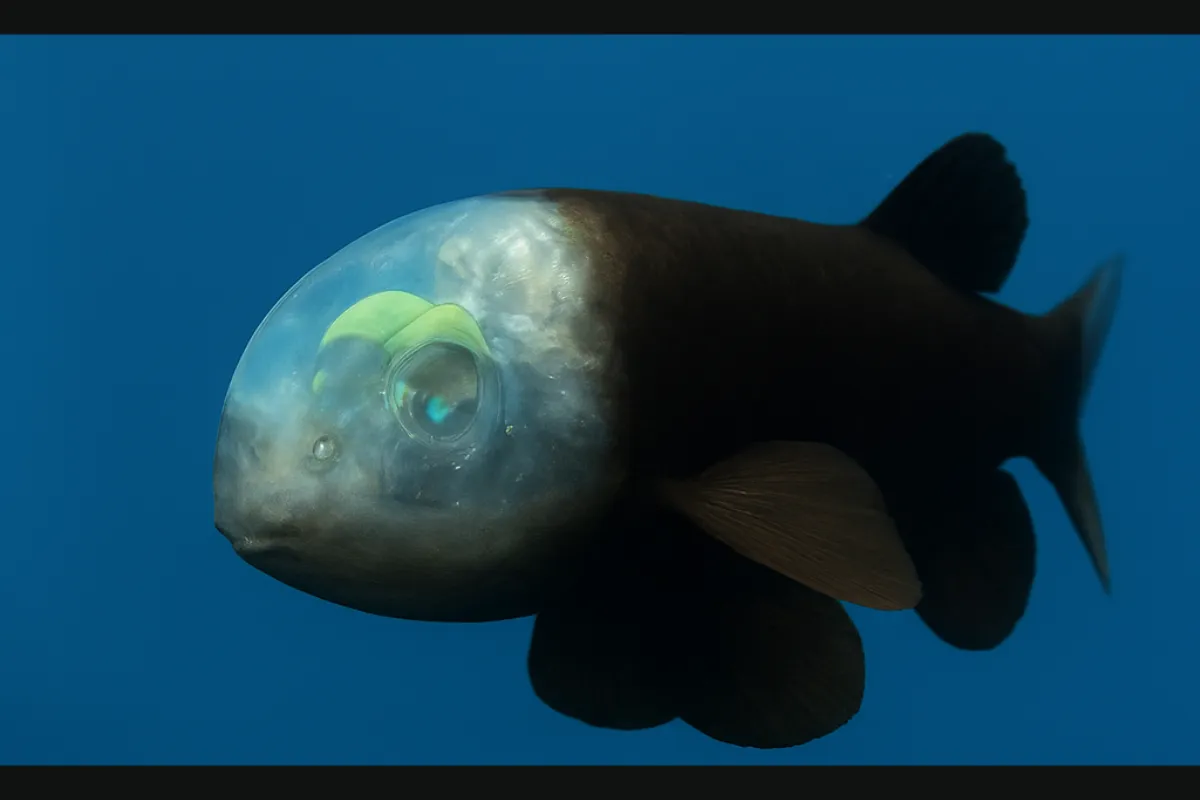
The Pacific Barreleye (Macropinna microstoma) is one of the most fascinating and unusual creatures found in the deep ocean. Known for its transparent, dome-shaped head and upward-facing green eyes, this rare fish has intrigued scientists and ocean explorers for decades.
Discovery and Habitat
First described in 1939, the Pacific Barreleye inhabits the dark depths of the Pacific Ocean, usually at depths ranging between 600 to 800 meters (2,000–2,600 feet). This zone, known as the twilight or mesopelagic zone, receives little sunlight, making it an environment where unusual adaptations are critical for survival.
Unique Adaptations
What sets the Pacific Barreleye apart is its see-through head. Its transparent dome allows the fish to collect more light in the pitch-black waters of the deep sea. Inside this dome, its tubular eyes rotate both forward and upward, giving it the ability to track prey above while still swimming horizontally.
The green lenses of its eyes act as filters, reducing the glare from the sunlit waters above and helping it spot faint silhouettes of prey. This remarkable adaptation makes the Barreleye a highly efficient hunter in near-darkness.
Feeding Behavior
Pacific Barreleyes primarily feed on plankton, jellyfish, and small drifting organisms. Researchers believe the fish carefully maneuvers around the stinging tentacles of siphonophores—colonies of jellyfish-like creatures—to steal food without being harmed. Its small, toothless mouth suggests it is adapted for a selective diet rather than aggressive predation.
Conservation and Significance
Though not widely studied due to the challenges of deep-sea exploration, the Pacific Barreleye serves as a living example of how life can evolve extraordinary solutions to extreme conditions. Its unique biology continues to inspire scientists and ocean enthusiasts alike, shedding light on the mysteries of Earth’s last unexplored frontier—the deep sea.