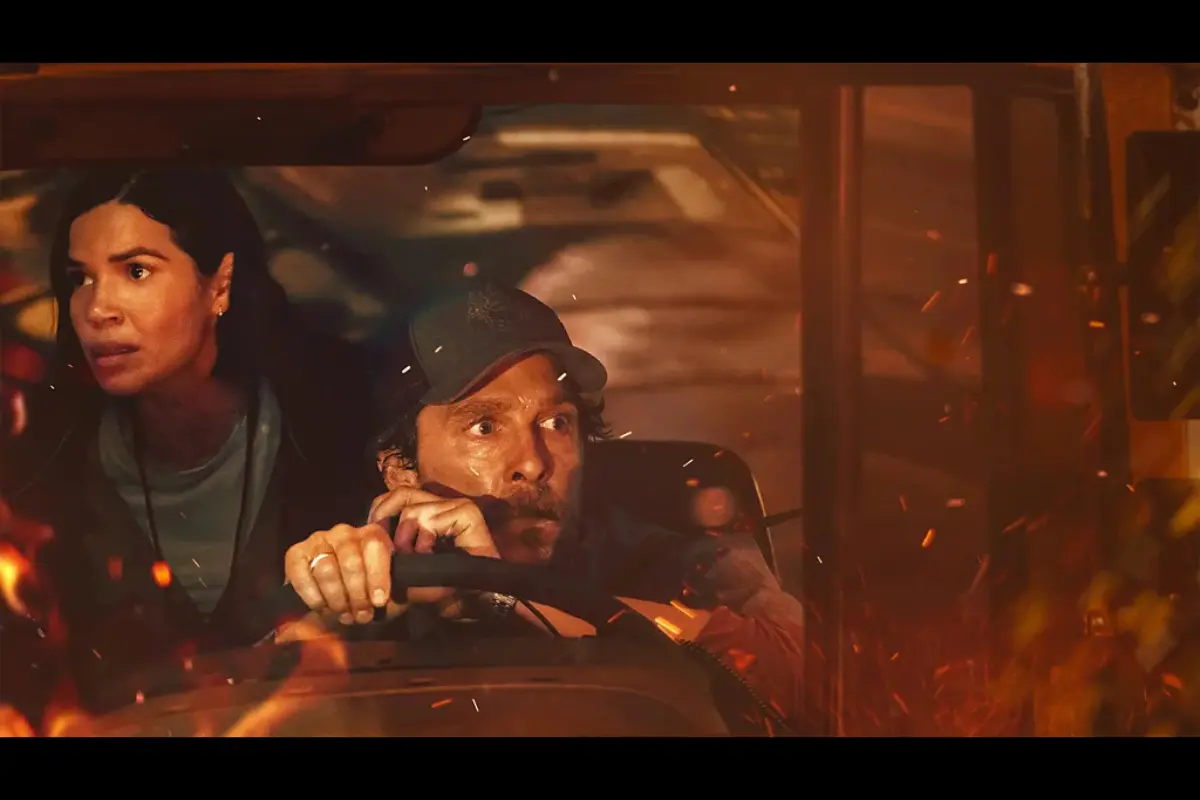
Paul Greengrass’s The Lost Bus is a gripping survival drama that transforms real-world horror into stirring cinema. Based on the true events of the 2018 Camp Fire in Northern California, this film draws you into the chaos of disaster—but also into the heart of ordinary people rising to extraordinary duty.
Story & Premise
The film follows Kevin McKay (Matthew McConaughey), a school bus driver with a life in tatters—estranged from his son, burdened by financial woes and loss, trying to care for an elderly mother. On the worst day of his life, he’s called upon to ferry a group of schoolchildren and their teacher, Mary Ludwig (America Ferrera), to safety as the Camp Fire burns around them. What begins as a simple evacuation becomes a desperate fight for survival amid smoke-choked roads, failing infrastructure, and mounting panic.
What Works Well
-
Immersive Direction & Tension
Greengrass is in his element here. His signature handheld camera work, abrupt cuts, and auditory pressure (crackling fire, rumbling wind, screaming silence) make the danger feel immediate. Several sequences—from huddling in traffic while ash falls, to Mary stepping off the bus to fetch water—are visceral and terrifying. -
Strong Performances
Matthew McConaughey delivers one of his most grounded performances in recent years. His character is flawed and fragile, yet under pressure he finds a kind of grit and humanity. America Ferrera complements him well: as the teacher who must both lead and protect, she brings a mix of steadiness and urgency. Together, they anchor the film when the story threatens to drift into spectacle. -
Technical Mastery
The visual and sound design are exceptional. Smoke, fire, and darkness are used not just as effects but as characters themselves. The film often places the audience in nearly claustrophobic scenarios, the camera pushing close, sound mixing drowning dialogue in ambient chaos. For a disaster movie, it feels real and uncomfortably close.
What Doesn’t Fully Land
-
Uneven Character Development
Besides Kevin, Mary, and a few others, many characters—especially the children and supporting family members—remain thinly sketched. Some of Kevin’s personal backstory, particularly family dynamics, feel overly dramatized and inserted with exposition rather than unfolding naturally. -
Emotional Overload vs. Narrative Clarity
The first act leans heavily into setting up Kevin’s suffering—his dog dying, his strained relationships, financial pressures—which can sometimes feel calculated. While the intention is to deepen empathy, it occasionally distracts from the central tension of the wildfires and rescue. Once the fire fully takes over, though, the film’s pacing improves significantly. -
Limited Focus on Underlying Causes
The film briefly touches on the causes of the wildfire—drought, climate change, utility company negligence—but doesn’t dig deeply. More exploration of systemic failures could have elevated it from a personal survival tale into a broader commentary on accountability.
Overall Impression
The Lost Bus is a powerful drama of survival and heroism. It isn’t perfect—but it doesn’t need to be. Its strength lies in portraying a true catastrophe through human eyes, celebrating courage under fire, and forcing the audience to reckon with how fragile safety can be. For those who appreciate disaster films that go beyond spectacle to deliver heart, this is one of the more memorable ones in recent years.
Rating: 3.5 / 5 stars