
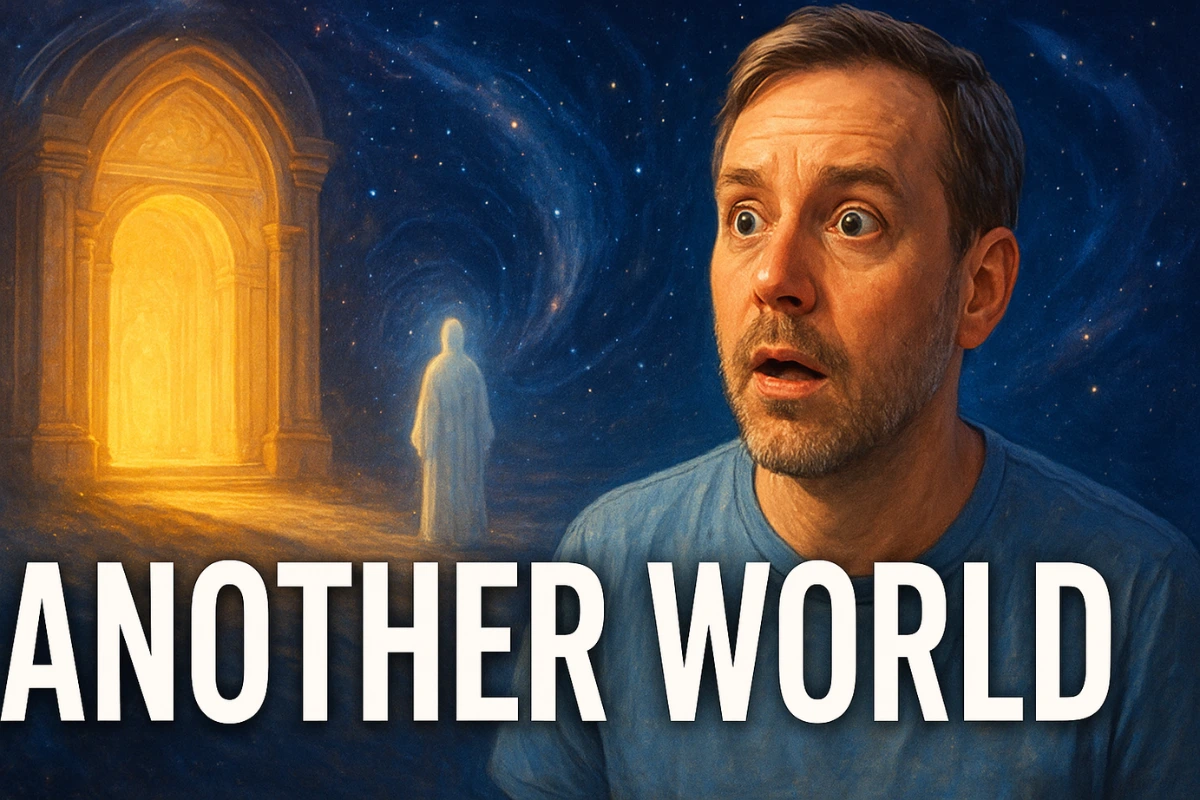
A man who was clinically dead for six minutes during a surgical complication claims he crossed into an entirely different realm—an experience he describes as more vivid and real than life itself. His story, featured on the YouTube channel Shaman Oaks, aligns with what experts commonly refer to as a near-death experience (NDE), often reported after cardiac arrest, severe trauma, or coma.
John Davis recounted that the incident took place while he was visiting his parents. He was riding their moped when he swerved to avoid a squirrel and slammed into a tree, leaving him with serious nerve injuries in his right arm. But the true turning point happened during surgery when an unexpected reaction to the anesthesia caused his heart to stop.
“The moment I shut my eyes and died, the next moment I opened them in a completely different world,” Davis said.
A Place He Calls a ‘Soul Orientation Centre’
According to Davis, he suddenly found himself inside a grand marble structure filled with gleaming surfaces, beautifully crafted doors, and several passageways stretching into mysterious distances. He wasn’t alone—there was a calming presence beside him, though he couldn’t see a physical form.
“My guide told me this was an orientation centre, a transition point for souls after death,” he explained.
Davis described looking through one tunnel that opened into a swirling river of stars and galaxies. In another passageway, he saw a man who had recently died being welcomed by a woman whose appearance seemed to shift backwards in age.
In what he described as a vast garden, he said he was greeted by animals he once loved—two dogs and two cats—running joyfully toward him. But the moment that stayed with him the most was seeing a radiant figure dressed in a robe with a red sash.
“You must tell them death does not exist,” the glowing figure told him.
Immediately after this message, Davis regained consciousness in the hospital as doctors were trying to revive him.
Although he was medically dead for six minutes, he claims the encounter felt like it lasted nearly two hours.
Understanding ‘Death’ from a Medical Perspective
Emergency physician Dr. Daniel Mark Rolston from Northwell Health in New York explained to Live Science that being “clinically dead” typically refers to cardiac death, where the heart stops beating and the brain loses its blood supply. Within five minutes of oxygen deprivation, brain cells begin to break down irreversibly.
Another form of death, brain death, occurs when the brain sustains such heavy damage that it cannot regulate vital processes such as breathing or heart function.
What Experts Say About Near-Death Experiences
Studies show that NDEs are more common than many assume. According to a BBC report, around 15% of ICU patients in the US have described such experiences, often involving bright lights, tunnels, sensations of leaving the body, or overwhelming feelings of peace.
Researcher Dr. Gregory Shushan has chronicled NDE reports across continents and centuries—from ancient China to pre-colonial Africa—suggesting that these experiences share striking similarities worldwide.
However, neuroscientists believe NDEs may arise from brain mechanisms rather than supernatural forces. In 2024, University of Michigan scientists monitored the brain activity of four dying patients and observed a sudden spike in neural activity just after life support was withdrawn—mirroring earlier findings in animals.
The study also detected increased connectivity in the prefrontal cortex, a region tied to awareness and decision-making. “This strongly suggests the dying brain can activate intensely,” the researchers concluded, offering a potential neurological explanation for the powerful visions many people report during near-death states.